

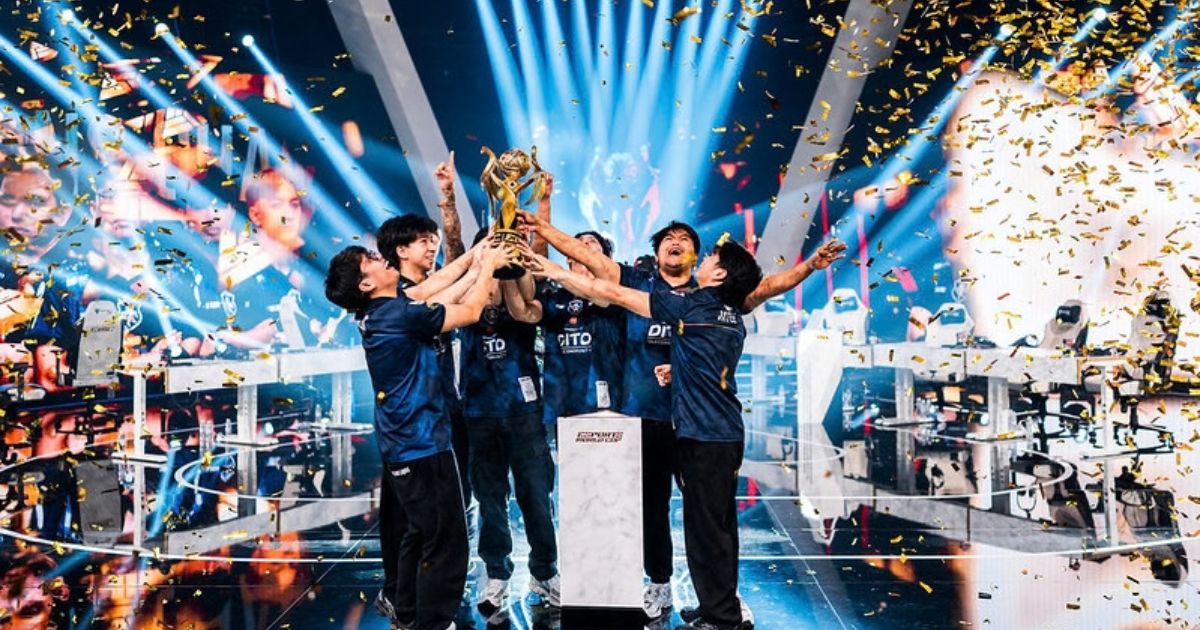
As BEYOND Conference 2026 reveals the schedule for its Experience day on November 24, Professor Andy Miah, University of Salford, considers the year’s sporting mega-events, which pushed broadcast technology further than ever. What next? And what is still missing for audiences?
The world has enjoyed yet another spectacle of sporting theatre, with the Olympic Winter Games in February, the FIFA Men’s World Cup in June and July, and the Esports World Cup across August.
Each of these took new creative technology innovation to a new level. At the Olympics, first person view drones filmed the athletes in competition, at the World Cup, real-time 3D renders of the match were attached to the television coverage, and at the Esports World Cup used AI-cameras to make even more dynamic streaming experiences.
For decades now, sporting mega-events have occupied a fascinating space in the public imagination, where their existence is predicated – financially – on television audiences and the revenues they generate, but where they rely heavily on the physical experience economy – of audiences showing up around the world to witness history and producers staging the creative vision. Everyone who works with such events, or who has attended, knows that people assembling together in physical space remains crucial in an increasingly mediated world.
During COVID, we saw just how crucial these two components are to the realisation of historic events. Without audiences at physical events, something rich was lost, both in terms of the excitement, but also the historic record. However, the same is also true of the remote audiences and we often neglect this; they work in synergy to produce the event experience, but how best can they be drawn together?
The creative challenge for the storytellers is to bridge these worlds: to construct a coherent narrative that reaches across the physical and, now, digital divide.
If you are lucky enough to be physically present at a mega-event – with all of its richness – you may feel disconnected from the collective memorialising that takes place via the stewardship of the host broadcaster creatives, the presenters and commentators who tell the story of the event to the nation. Alternatively, if you are watching remotely, you lose the sensorial complexity and feeling of bearing witness to history in front of your eyes, metres from you.
Creatively, there remains a huge opportunity to bring these two experiences together, to give the remote audience a sense of being there physically and, for the live audience, a feeling of how that story is being told to a nation, but how to do it well?
Some of the answers are found in a recent essay by Francois-Charles Bideaux, brought to my attention by Olympic Broadcasting Services Chief Yiannos Excarchos. It explains the process that sits behind the creative direction that is the storytelling community of these worlds and there’s something instructive for how we think about the event economy in these hybrid times.
Understanding sporting competitions as foundations in a process of wider, creative story offers insight into what events need to become, in order for them to grow and retain their role as defining history. Indeed, even since the early years of the Olympic Games, these ambitions were apparent and are often discussed in the context of Leni Riefenstahl, whose cinematic contributions served to elevate and document the Berlin 1936 Olympic Games. While celebrated and decried in equal measure, the work is unanimously recognised as a pivotal moment in Olympic history, marking out the beginning of the moving image as historical arbiter.
Furthermore, journalists have always understood their role in balancing the reporting of historical events, alongside provoking the audience’s appetite for these to be moments to be told as compelling stories, but how this feeds experience is fascinating, especially now.
Today, we are moving into a new, creative technology reality, where hyper-personalised media storytelling is possible. Festival goers navigate their experience with digital check-ins, making it theoretically possible to deliver unique highlight films of their festival memories, integrated with price points for premium consumer content.
In each of these cases from 2026, the creative challenge to the architects of the experience economy is the same: to grapple with the disconnection between the physical and the remote experiences and to bring them together to forge collective memories.
Having lived through each of these experiences, I have found there to be great power in being the witness to each. Those who bear witness to the moment, as it happens, in front of their eyes enjoy the privilege of sharing the space with all of its sensorial vigour, from the journey to the field of play to the tremor of the arena as it erupts in celebration.
Those who watch the drama unfold through the screens in their living rooms, live sites, or bars, have the ability to witness every angle of the action, sit in every seat in the house alongside their commentator companions. These participants enjoy the narrative construction as it happens, becoming drawn into the choreography, heightening the excitement.
Bringing these two experiences together is the next creative challenge of the experience economy and it will require the best of our creative technologists, event directors, film makers, script writers, musicians, and performers to realise.
Join me for Mapping the New Experience Economy, as I set the agenda for day one of BEYOND, by examining the forces redefining how experiences are created and valued. From audience behaviours and AI-driven discovery to participatory culture and the convergence of physical and digital space, I’ll reveal a sector in transition. Drawing on events, festivals, sport and place-based innovation, the session will identify the shifts that policymakers, researchers and producers need to understand and act on now.
Professor Andy Miah
_ _ _
Professor Andy Miah, PhD, is Chair of Science Communication & Future Media at the University of Salford, Manchester, where he is also the Academic Champion for the Ethics of Artificial Intelligence. His research investigates the ethical, legal, social and cultural questions concerning technological change and his publications draw on ideas from science, technology, art, and media culture.
This article featured in BEYOND Studio’s monthly newsletter, Creative Economy Digest, independently produced for those working at the intersection of culture, research, and emerging technologies. SUBSCRIBE
Image: MSC at EWC 25 by Lee-Aik-Soon